Articulation (speech sounds)
Speech therapy for kids who are hard to understand
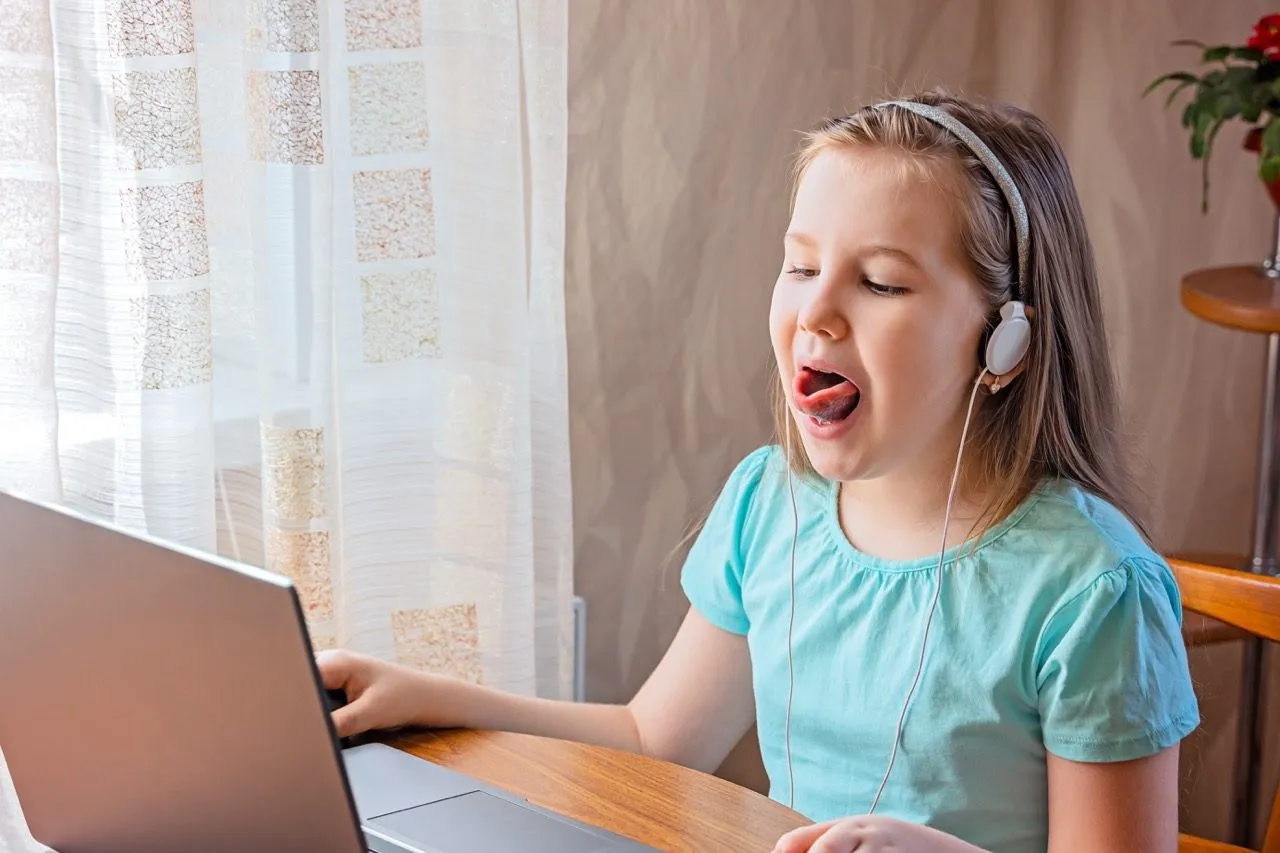
Articulation therapy can help kids, ages 3 to 17, who are hard to understand or have difficulty producing certain sounds in words or sentences. Your therapist works with you and your child by video, using online activities and close-up modeling, and gives you materials to continue practicing at home.
- Ages 3 to 17
- 30-minute sessions by video
- Parent coaching in every session
- Anywhere in Texas
Good to know
The short version
- Sounds develop at different ages, so some mistakes are developmentally appropriate depending on your child's age.
- If your child is harder to understand than other kids their age, an evaluation can tell you whether therapy would be helpful.
- A few minutes of practice a day can support progress toward articulation goals.
Who it helps
Is this right for my child?
- Preschoolers who are hard for family or strangers to understand
- Kids who swap one sound for another, like "tat" for "cat" or "wabbit" for "rabbit"
- School-age kids still working on sounds like r, s, l or th
- Kids with a lisp
- Kids with speech sound errors who also have trouble with words and sentences
Signs to watch for
What signs should parents watch for?
-
Age: Age 3
- Family members have trouble understanding your child much of the time
- Leaves off the beginnings or ends of many words
-
Age: Ages 4 to 5
- People outside the family often can't understand your child
- Uses one sound in place of many others, like "t" for "k," "g," "s" and "sh"
-
Age: Ages 6 and up
- Still has trouble with sounds like r, s, l or th
- Has a lisp, where s and z sound slushy or like "th"
-
Age: Any age
- Gets frustrated, avoids talking, or is teased about how they talk
If you are seeing one or more of these in your child, it may be worth taking a closer look with a speech evaluation.
Online sessions
What therapy looks like
-
What happens in a session?
Your therapist shows your child how to make a sound, using a close-up view of their own mouth, pictures and simple cues. Then your child practices in games on the screen, working up from single sounds to words, sentences and conversation.
Video works well for speech sounds as long as you have a decent camera and a quiet room.
-
What will I do?
With younger kids, you sit nearby, help them stay focused, and learn how to practice their sounds at home. Older kids often work on their own, and you join for the last few minutes. Home practice is short, just a few minutes every day with target word lists, reading practice, and natural modeling of their speech sounds.
-
How is progress tracked?
Testing for speech sound production is completed at the evaluation, and we set goals together for targeting specific sounds. In each session, your therapist tracks your child's accuracy, from words up to conversation, and we go over it with you regularly. There is no specific timeline for how long each goal will take, but we will provide updates each session so you know how we are progressing.
Learn more
What’s the difference between articulation and phonology?
Both are speech sound problems. An articulation error affects how one sound is made, like a lisp on s. A phonological pattern affects a group of sounds the same way, like saying every k and g sound in the front of the mouth (“tat” for “cat,” “doe” for “go”). The evaluation tells us which one we are observing, because the way therapy is conducted can be different.
How does the evaluation work online?
First, we’ll ask about your child’s history and what you’ve noticed at home. Then we will observe your child through play and talking exercises so that we can hear every sound produced in different parts of words. We’ll also check how well your child understands and uses language. Before the hour is up, you will be provided with results and recommendations so we can discuss the next steps.
Pricing
Simple, clear pricing
One price list for everyone, and you pay per visit. We don't bill insurance, but we can provide you with a superbill for you to send to your insurance company for out-of-network coverage. We do accept HSA and FSA cards.
See pricing-
Evaluation
$175
60 minutes
-
Therapy session
$75
30 minutes
-
Consultation call
Free
15 minutes
Related services
You might also be looking for
-
Early language skills
For babies and toddlers who are not yet talking or have only a few words, or who need support with understanding language and communicating their basic wants and needs.
-
Fluency (stuttering)
For kids and teens who have difficulties with fluent speech production. We can help with strategies to support fluency and the confidence in your communication skills.
-
Social communication
For kids who have difficulty interacting with other kids, taking turns in play or in conversations, understanding emotions, nonliteral language, or picking up on tone of voice.
Questions
Questions parents ask
Still wondering about something? A free 15-minute call is a good place to ask.
Will my child grow out of it?
Some sound mistakes are normal in young kids and go away on their own. Others don't. An evaluation compares your child's sounds to what's expected for their age and tells you whether therapy will help.
Can you really work on speech sounds over video?
Yes. With a decent camera and a quiet room, your therapist can see and hear your child clearly and show them how to make each sound. Games on the screen keep practice fun.
What about language delays, like using short sentences?
The evaluation looks at language as well as sounds. If your child also has trouble with words or sentences, those goals go in the same plan. We don't have a separate language delay program.
How often will my child have sessions?
Your therapist will recommend a schedule after the evaluation, often once or twice a week. You book sessions one at a time, so you can change the schedule as things change.
Can my child get speech therapy at school and with you?
Yes. Plenty of kids get speech at school and see us too. Just let both therapists know so they can work on the same goals.
Do you treat childhood apraxia of speech?
We don't have a dedicated apraxia program. If the evaluation points to a motor speech problem like apraxia, we'll tell you and help you decide what to do next.
Ready when you are
Most families start with a 60-minute evaluation. If you'd rather talk first, book a free 15-minute call and ask us anything.

Reviewed by Whitney Silverthorn, M.S., CCC-SLP, speech-language pathologist at Talking Jay.
Sources: Speech Sound Disorders: Articulation and Phonology (Practice Portal), American Speech-Language-Hearing Association; Telepractice (Practice Portal), American Speech-Language-Hearing Association; The efficacy of telehealth-delivered speech and language intervention for primary school-age children: a systematic review, Wales, Skinner and Hayman, International Journal of Telerehabilitation (2017)